Xi'an Jiaotong University Has Made New Progress in The Design Of Low-cost, High-strength And Tough Titanium Alloys
Nov 02, 2022
Xi'an Jiaotong University has made new progress in the design of low-cost, high-strength and tough titanium alloys
High specific strength titanium alloy is an important structural material for energy saving, emission reduction and lightweight. Its macroscopic mechanical properties can be optimized by adjusting the density and spatial distribution characteristics of grain boundaries (GBs) and out-of-phase interfaces (PBs). For example, regulating the structure and characteristics of the α/β phase interface with discontinuous lattice in titanium alloys can significantly improve the mechanical properties of the alloy.For titanium alloys, in addition to the diffusion (β→α) phase transition, high-density PBs can also be introduced into the titanium alloy through the non-diffusion displacement transition (β→α') under rapid cooling conditions.The martensitic phase transition in titanium alloys can realize two key advantages: on the one hand, the phase transition is driven by rapid cooling (the thermal stability of the high temperature phase is reduced) to construct a biphasic microstructure and produce interfacial hardening; on the other hand, the phase transition induced by force (the mechanical stability of the room temperature phase is reduced), usually manifested as a lower yield strength, but a higher work hardening capacity and fracture elongation, that is, the phase transition induces plasticity effect.Generally speaking, martensitic strengthening conforms to the classic Hall-Petch relationship. Therefore, it is desirable to design nano-martensitics in the microstructure to strengthen the alloy and maintain reasonable ductility, thereby obtaining excellent mechanical properties.However, since the larger β grains with a size of tens or even hundreds of microns in titanium alloys tend to form micron-level and submicron-level martensitic sheets, the phase interface density is low and the yield strength is not high.Therefore, the use of grain boundary engineering (GBE) to construct high-strength tough titanium alloys with fine microstructure is still a challenge.
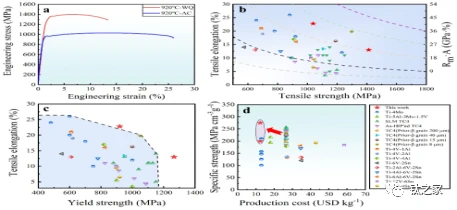
In view of the above problems, the team of Academician Sun Jun, State Key Laboratory of Metal Materials Strength, Xi'an Jiaotong University, proposed a new strategy for manufacturing nano-martensites using chemical interface Engineering (CBE), which is different from the grain boundary engineering that used traditional thermomechanical processing methods in the past.Based on the design idea that the significant diffusion mismatch between alloying elements at high temperatures can construct a high-density chemical interface (CBs, defined as the discontinuity of the concentration gradient of at least one element in a continuous area of the lattice), the team considers the difference in the diffusion rate of different alloying elements in the BCC-Ti and HCP-Ti matrices, and selects the low-cost fast-diffusion element Cr and the slow-diffusion element Al, using Ti-xCr-4.5 Zr-5.2 Al (x=1.8, 2.3, 2.8 wt.%) As a model material, the alloy regulates the density of the chemical interface through the fast diffusion element Cr.The diffusion mismatch of Cr and Al elements at high temperature forms a high-density CBs, which can divide each β grain into a large number of Cr-poor and Al-rich nano-domains.In the subsequent water cooling process, martensite (structural transformation) is more likely to nucleate in these Al-rich or Cr-poor nano-domains, that is, these Al-rich or Cr-poor nano-domains serve as nano-martensite nuclear sites, while the chemical interface serves as a barrier to the growth of martensite, limiting its rapid growth.Based on the CBE concept, the team successfully created the smallest nano-martensitic to date in the Ti-2.8 Cr-4.5 Zr-5.2 Al alloy (the average size is 20±6nm, as shown in Figure 1).At the same time, the titanium alloy has the lowest cost, highest specific strength and excellent strong plastic matching of all martensitic titanium alloy materials currently reported (as shown in Figure 2), and has good application prospects.The chemical interface engineering design strategy proposed by the team breaks through the limitations of the original microstructure/alloy composition design concept and thermomechanical processing method of titanium alloy, and provides new ideas for the design of high-performance advanced titanium alloys and other metal structural materials with similar characteristics. Structural materials.
Microstructure and composition distribution of multi-level nano-martensitic Ti-2.8 Cr-4.5 Zr-5.2 Al alloy after water cooling

Mechanical properties of multi-level nano-martensitic Ti-2.8 Cr-4.5 Zr-5.2 Al alloy at room temperature after water cooling and air cooling