


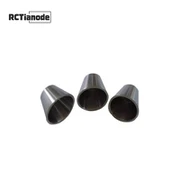
Gr1 Titanium Blind Flange
Gr1 titanium Blind flange
1.Material: Gr1 titanium
2.Size: According to customer's size
3.forge type: die forging,Free forging,
Gr1 Titanium Blind flange
Gr1 Titanium Blind flange is a solid plate used to block pipe equipment, etc. at the junction of two flanges. Up to 96", flange grades range from 150# to 10,000#. Blind flanges are made of convex or annular tongue-jointed gasket surfaces. Blind flange products are available in series A (MSS SP44) and series B (API 605) and conform to ASME/ANSI B16.5 and B16.47. The production process is mainly divided into forging, casting, cutting, rolling
The flange cast out, the blank shape and size is accurate, the processing amount is small, the cost is low, but there are casting defects (pores. Crack. Inclusion); Poor streamlining of the internal structure of the casting (even worse if it is a cutting part);
The advantage of Gr1 titanium blind flange is that a more complex shape can be made, the cost is relatively low;
The difference between cast flange and forged flange from the production process, such as centrifugal flange is a kind of cast flange.
Centrifugal flange is produced by precision casting method. Compared with ordinary sand casting, the casting structure is much finer, the quality is improved a lot, and it is not easy to appear problems such as loose organization, porosity and trachoma.
Forging flange
Forged flange is generally lower carbon content than cast flange is not easy to rust, forging streamlined, compact structure, mechanical properties are better than cast flange; Improper forging process will also appear grain size or uneven, hardening crack phenomenon, forging cost is higher than casting flange.
Forgings can withstand higher shear and tensile forces than castings.
Forgings have the advantage of uniform internal structure, without harmful defects such as pores and inclusions in castings.
Let's understand the production process of forging flange:
The forging process generally consists of the following procedures, that is, selecting high quality billets for blanking, heating, forming and cooling after forging. The forging process includes free forging, die forging and tire film forging. During production, different forging methods are selected according to the size of forging quality and the number of production batches.
Free forging productivity is low, machining allowance is large, but the tool is simple, universal, so it is widely used for forging single and small batch forgings with simple shape. Free forging equipment has air hammer, steam - air hammer and hydraulic press, respectively suitable for small, medium and large forgings production. Die forging high productivity, simple operation, easy to realize mechanization and automation. Die forging has high dimensional accuracy, small machining allowance and more reasonable distribution of fiber structure, which can further improve the service life of parts.
Free forging
Basic working procedure: in free forging, the forging shape is forged gradually through some basic deformation procedures. The basic processes of free forging include upsetting, drawing, punching, bending and cutting.
1. Upsetting upsetting is the operation process of forging the original billet along the axial direction to reduce its height and increase its cross section. This process is often used for forging gear billets and other disc forgings. Upsetting can be divided into total upsetting and local forging.
2. Drawing is a forging process that increases the length of the blank and reduces the section. It is usually used to produce the blank of shafts, such as lathe spindle and connecting rod.
3. Punching the forging process of punching out the through hole or through hole on the blank.
4. Bending Forging process in which billets are bent into a certain Angle or shape.
5. Twist the forging process that makes one part of the billet rotate at an Angle relative to another part.
6. Forging process of cutting and dividing blank or cutting material head.
Die forging
Die forging is called model forging. The heated blank is placed in the forging die fixed on the die forging equipment.
1. The basic process of die forging die forging process: blanking, heating, pre-forging, final forging, punching even skin, trimming, quenching and tempering, shot peening. Commonly used processes are upsetting, drawing, bending, punching, forming.
2. Common die forging equipment commonly used die forging equipment are die forging hammer, hot die forging press, flat forging press and friction press, etc.
Generally speaking, forged flange quality is better, generally through die forging production, crystal structure is fine, high strength, of course, the price is also a few more expensive. Whether cast flange or forged flange is a commonly used flange manufacturing method, depending on the strength requirements of the parts to be used, if the requirements are not high, you can also choose turning flange.
Cutting system of the flange
The inner and outer diameter and thickness of the flange are cut directly on the middle plate, and then the bolt hole and waterline are processed. The flange produced in this way is called cut flange. The maximum diameter of this flange is limited to the width of the middle plate.
Rolling flange
The process of cutting slivers from the middle plate and then rolling them into a circle is called rolling and is used in the production of some large flanges. After successful rolling, welding, flattening, and then the waterline and bolt hole process.
If you need the Gr1 blind titanium flange.Please feel free to contact with us.
Hot Tags: gr1 titanium blind flange, suppliers, manufacturers, factory, customized, wholesale, bulk, pricelist, quotation, in stock, free sample, Gr2 Welding Neck Flange, Unalloyed Loose Flange, Gr1 Titanium Blind Flange





Send Inquiry
