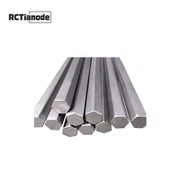
Classification of titanium alloys
Apr 12, 2022
Titanium alloys are classified as α, α–β or β alloys.Gr1,Gr2,Gr3 are industrial pure titanium in α alloy, and Ti-5Al-2.5Sn is a typical type of α titanium alloy.The advantages of α titanium alloy are relatively stable structure, good welding performance, and good thermal strength. Its disadvantage is that it has poor plasticity at room temperature and easy to fracture, but the plasticity can be improved when heated. α titanium alloy is generally used in various components with long-term work below 500℃and parts with corrosion resistance requirements. Ti-13V-11Cr-3Al was the first commercially significant β alloy. β titanium alloys offer highest specific strengths, toughness and fracture resistance,while they are limited by a small processing window and higher costs. β alloys are generally used in the solution-treated and aged condition. Compared with α alloy,(α+β) titanium alloy has poor heat resistance and welding performance, while the room temperature strength and other properties will be stronger than the α type.A few important (α+β) alloys include Ti-3Al-2.5V, Ti-5Al-2Sn-2Zr-4Mo-4Cr (Ti-17), Ti-6Al-2Sn-2Zr-2Mo-2Cr-0.25 Si, Ti-6Al-2Sn-4Zr-6Mo, and Ti-6Al-6V-2Sn.Ti-6Al-4V is the most extensively used alpha-beta alloy, this titanium alloy has high thermal strength, thermoplastic, suitable for hot forging, low temperature toughness and comprehensive mechanical properties are also good.At higher temperature, the stability of the structure is weaker than that after annealing, so usually it is not used for heat treatment strengthening, generally used in annealing state. (α+β) titanium alloy is mainly used for the manufacturing of guided missiles and aircraft engine part and other structural parts with high temperature strength requirements etc.