Design principle of titanium anode
May 16, 2023
First, the use of titanium anode requirements
From the actual needs of users, when the copper plating process is changed from phosphorus copper ball to titanium anode, the primary need is to effectively and stably improve the uniformity of plating, and thus bring about the improvement of quality; Secondly, the titanium anode quality is required to be stable, to achieve the expected service life and stable additive consumption level during this period, in order to ensure that the operation cost is controllable. Therefore, in summary, the main requirements are the following points: excellent plating uniformity, stable service life, controlled additive consumption level.
For anode manufacturers, how to translate customer requirements into internal requirements for product design is the most important place for anode manufacturers to study and give corresponding support. For specific requirements, the requirements of plating uniformity are mainly determined by the mechanical design of the titanium substrate, while the other two requirements are closely related to the design of the coating.
2. Uniformity design of titanium anode discharge
The main mechanical design of titanium anode needs to match with the equipment, and the main work is completed by the equipment manufacturer. In the face of how to optimize the design of titanium anode discharge uniformity, the anode manufacturer should give corresponding suggestions and support, which can be considered from the following aspects.
1. Resistivity problem
The resistivity of titanium material is the first point to be paid attention to in the uniformity design of titanium anode discharge. When the phosphorus copper ball is used, the anode current is introduced through the whole titanium basket, and the conduction resistance inside the anode through the copper ball is basically negligible. And the use of titanium anode, due to the relatively poor conductivity of titanium material, especially when the titanium anode working in a high current density, the current through the upper anode to the lower part, the resistance of the titanium material will lead to the voltage from top to bottom is significantly reduced. As a result, the discharge current density at the bottom of the titanium anode is significantly lower than that at the top of the titanium anode.
In the anode design, the primary consideration is how to reduce the voltage drop caused by the long distance conduction of titanium material. It can be optimized mainly through the following two aspects: (1) Reduce conductive resistivity, use wider and thicker titanium materials for current conduction, or use titanium copper composite materials to assist current conduction; (2) Disperse current conduction points. Multiple current conduction points are arranged on the anode surface to avoid too long transmission distance.
2. Targeted optimization of anode substrate type
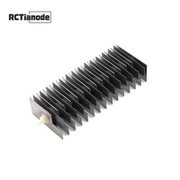
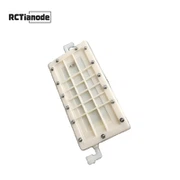
At present, in the design of titanium anode, there are basically two types of anode substrate selection: one is titanium plate, the other is titanium mesh.
Titanium mesh is made of titanium plate punching and stretching, its main advantages are that titanium mesh can only be double-sided coating, even if it is not facing the back of the product, because the mesh material is hollow structure, the back coating can also participate in the discharge, so the effective discharge area of the entire mesh anode is larger than the titanium plate, which can reduce the actual anode working conditions of the current density. Mesh anodes tend to have less mechanical strength and higher electrical resistivity than plate anodes. To solve the above problems, the uniformity and discharge uniformity of titanium mesh anode can be improved by designing a suitable frame and optimizing the position of solder joint.
The biggest advantage of using a plate anode is that the substrate can be reused. After the anode coating fails, the residual coating can be peeled off and the substrate surface can be thoroughly cleaned before the coating can be reapplied, thus saving some long-term costs in future anode applications (although the one-time investment will be slightly larger). On the other hand, the substrate thickness of plate anode is usually 2mm and 3mm, and the mesh anode is generally suitable for drawing by 1mm titanium plate (hollow in the middle), so the electrical conductivity of plate anode is better than the mesh anode. But this does not mean that plate anode discharge uniformity is necessarily better than mesh anode. The overall mechanical design of the plate anode is simpler than that of the mesh anode (with a frame), but there is room for optimization of the distribution of current access points for the plate anode if it is to meet the requirements of higher plating uniformity.
3, the influence of bubbles on conductive uniformity
Oxygen will be produced in the anode reaction during the titanium anode use, so the oxygen generation will form a shielding effect between anode and cathode, and affect the discharge uniformity to some extent. The resulting oxygen bubbles will float up, resulting in a gradient of the amount of accumulated oxygen bubbles in the upper and lower parts of the anode, resulting in a shielding effect and a gradient effect. The need to balance the shielding effect of oxygen bubbles on the homogeneity of the plating.
3. Design of catalytic coating
The design of anode coating is the core value of anode manufacturer. Titanium anode is a highly customized product, which is not only reflected by the variable processing shape of the substrate, but more importantly, for the needs of the client, the selection of appropriate coating formula design, in order to ultimately meet the personalized needs of customers as the ultimate goal. The coating structure includes the design of various processing and manufacturing links, such as the selection of specific raw materials, the adjustment of coating ratio and the change of coating sequence.
First, the design of the anode coating needs to be appropriate to the specific plating conditions. PCB copper plating conditions can be divided into DC electroplating and reverse pulse electroplating, and the coating design of the two copper plating conditions is completely different. If the wrong coating design is selected, it will not only fail to meet the final requirements of electroplating products, but also cause serious problems in the life and performance of the anode.
Secondly, how to achieve the life requirements of the anode coating, mainly rely on the actual conditions of use, as well as the customer's life expectancy requirements and other specific considerations. Determine the content of precious metals, not only according to the anode electricity amount of simple conversion, but also according to the conditions of use, such as the amount of organic matter in the potion, whether there is a serious impact on the anode life of the material existence, whether the equipment has a design defect caused by the anode can not work normally and other factors to determine. If the coating structure design is optimized, the precious metal consumption rate can be reduced to a certain extent. It is more practical and more important to select a suitable coating design scheme than to simply specify the precious metal content.
The most important part of anode coating design is the control requirement of additive consumption, which is the core part of anode coating design. In short, to control additive consumption, it is necessary to shield coatings with high catalytic activity to reduce the chance of direct contact with additives. Usually, this kind of special coating is called barrier coating. At the same time, we also need to optimize and adapt the coating design according to the different additives from different manufacturers and the different properties of additives. By changing coating properties (such as surface roughness, surface energy, charge properties, etc.), some additives can be adsorbed or repulsed, so that the consumption level of some additives can be adjusted to some extent. All in all, the design of the coating truly reflects the high degree of customization of the anode and the core expertise and competitiveness of the manufacturer.