Structural requirements of all-titanium containers
Oct 24, 2022
Structural requirements of all-titanium containers
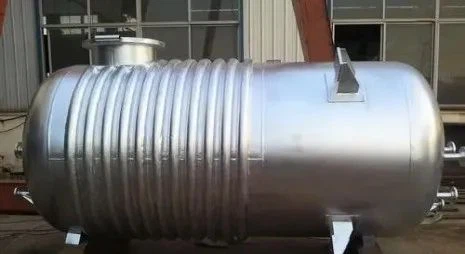
All-titanium containers refer to the main parts, such as the shell, head and takeover, which are made of titanium, and the secondary parts can be made of non-titanium. For example, the looper flange and its connecting bolts can also be made of carbon steel.
The minimum thickness of the all-titanium container shell is 2mm, which mainly considers meeting the thickness requirements of the welding process and ensuring geometric dimensional tolerances during manufacturing, meeting the stiffness requirements required during manufacturing, transportation and hoisting, and saving titanium to reduce costs.
Design selection principle
Science and technology are the hallmarks of human civilization.The progress and popularization of science and technology have provided mankind with new means of disseminating ideas and culture such as radio, television, film, video, and the Internet, and have given the construction of spiritual civilization a new carrier.
Since the mechanical strength of titanium material decreases significantly when the temperature is greater than or equal to 200℃, and the elastic modulus of titanium is low, therefore, the all-titanium structure is not suitable for high temperature, high pressure or medium pressure and large-scale equipment applications.
The allowable temperature of an all-titanium pressure vessel should not exceed 250℃, and it is considered that it is more economical to choose an all-titanium structure for small and medium-sized containers with a pressure of 0.5MPa and a temperature below 150℃.When calculating a thickness greater than 13mm from the consideration of investment costs, it may not be economical to use pure titanium.
Structural requirements
Although the all-titanium container is somewhat similar to stainless steel in structural design, due to some special properties of titanium itself, it has its uniqueness in design and processing and manufacturing. Therefore, when designing the structure, the following points must be paid attention to::
1. When designing the welding structure, the welding site must be made easy to operate with hydrogen arc welding tools, and all welding joint areas at high temperature (above 400℃) must be effectively protected.In the molten state, titanium can combine with almost any element, so special protection must be taken during welding and thermal processing.In order to achieve effective protection purposes, the structure and shape of the parts should be simple, and the takeover opening on the housing should be as perpendicular to the axis of the housing as possible, so that the protection fixture can be easily made and the protection effect is better.2. Strictly avoid welded structures where steel and titanium fuse with each other.Since other metals such as iron are melted in titanium welds, hard and brittle intermediate metal compounds will form, which greatly reduces the plasticity of the welds. Except for explosive welding and brazing, titanium and steel cannot be welded together.
3. The blunt edge gap of the butt welding joint should be appropriate.The blunt edge gap of the butt welded joints of all-titanium pressure vessels is smaller than that of steel. This is due to the high melting point, poor thermal conductivity, small heat capacity and large resistance coefficient of titanium, as well as the large metal fluidity of the welding bath.
4. The design of titanium containers should ensure the continuity of the structure and the smooth transition of the welded joints, and try to avoid stress concentration.
5. The bending and flanging of titanium parts should adopt a larger bending radius (compared with steel), and when expanding the tube, a smaller expansion rate should be used.
6. Industrial pure titanium is prone to crevice corrosion in certain media. When designing and handling containers in contact with these media, crevices and stagnant areas should be avoided as much as possible, and crevice-resistant titanium alloys (such as titanium-palladium alloys) or coatings should be used at the crevices. Corrosion-resistant titanium alloys (such as titanium-palladium alloys) or coatings.
7. When designing and handling containers in contact with conductive corrosive media, if it is found that titanium in contact with other metals can cause galvanic corrosion, measures should be taken structurally (such as using a third material as a transition layer) or anode protection.
8. When designing equipment that is prone to corrosion, the flow rate of the corrosive medium should be lower than the critical flow rate, and try to avoid sudden changes in flow rate or flow direction; or set up protective baffles in areas that are prone to corrosion and abrasion.
①when the medium is corrosive or abrasive and pv2>740kg/(m·s2) or the medium is non-corrosive or non-abrasive, but pv2>2355kg/(m·s2) (pv is the density of the medium, kg/m3, v is the linear speed of the material flow, m/s), an anti-punching plate should be set at the inlet of the material.
② When the corrosive medium enters the equipment tangentially, or the inlet pipe is facing the wall of the device, and the distance between them is less than 2 times the outer diameter of the pipe, a protective plate should be set.